ADVENT trial and AA burden sub-analysis data summaries.

ADVENT trial, AA burden sub-analysis, long-term outcomes study

Overview

The ADVENT trial is the first randomized clinical trial that directly compared FARAPULSE™ PFA (with the FARAWAVE™ Pulsed Field Ablation (PFA) Catheter) to standard-of-care thermal ablation—radiofrequency ablation (RFA) and cryoballoon ablation (CBA)—for the treatment of paroxysmal atrial fibrillation (PAF).

The ADVENT trial: AA burden sub-analysis compared FARAPULSE PFA (with the FARAWAVE PFA Catheter) to standard-of-care thermal for recurrent atrial arrythmia (AA).

The ADVENT long-term outcomes (LTO) study—an observational extension of the pivotal ADVENT trial—assessed effectiveness of FARAPULSE PFA (with the FARAWAVE PFA Catheter) vs thermal (RF or cryo) ablation out to 4 years.

In ANZ, the FARAWAVE Catheter is indicated for:

  • The isolation of pulmonary veins in the treatment of recurrent,  symptomatic Paroxysmal Atrial Fibrillation (PAF).
  • The isolation of pulmonary veins and the posterior wall in the treatment of drug-refractory, symptomatic Persistent Atrial Fibrillation.

About the study: ADVENT LTO

The ADVENT long-term outcomes (LTO) study1—an observational extension of the pivotal ADVENT trial—assessed AFib progression in patients out to 4 years (N=364, n=183 PFA, n=181 thermal ablation) who received ablation treatment with either FARAPULSE PFA (using the FARAWAVE™ PFA Catheter) or thermal (RF or cryo) ablation. This is the first long-term comparison of PFA vs thermal ablation from a randomized trial cohort following patients out to 4 years.


Key findings: ADVENT LTO

FARAPULSE PFA delivered greater effectiveness versus thermal ablation out to 4 years and comparable safety, with no long-term safety concerns observed.

Heart in hands icon.
Greater long-term effectiveness

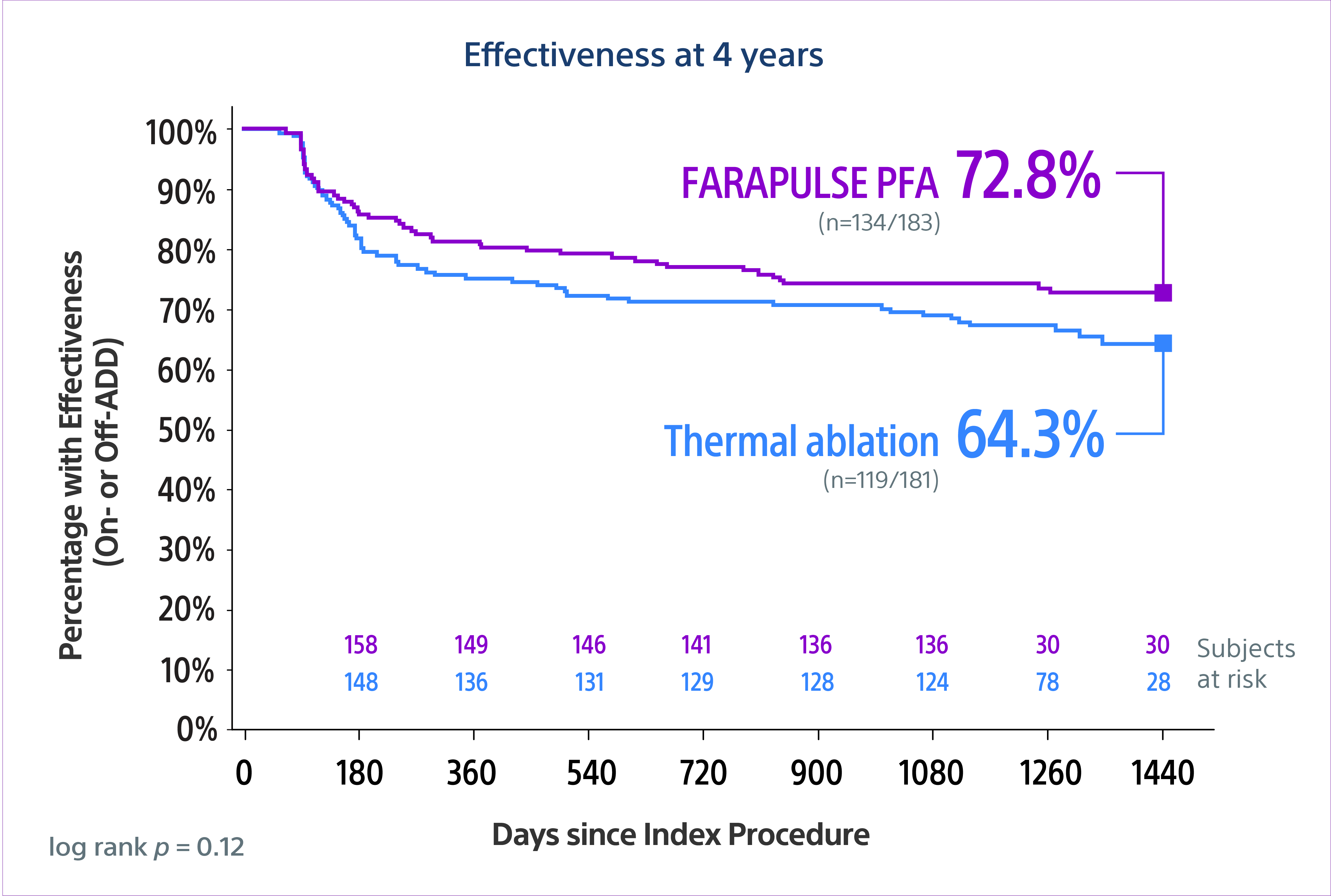
73.8% (n=134/183) effectiveness at 4 years vs 64.3% (n=119/181) for thermal ablation (p=0.12)

Hospital icon.
Fewer hospital-based interventions 

85.6% (n=158/183) freedom from hospital-based interventions at 4 years vs 78.6%(n=144/181) for thermal ablation (p=0.08)

Heart icon.
Patients more likely to stay off anti-arrhythmic drugs (AADs)

11.5% (n=21/183) were prescribed AADs out to 4 years vs 20.4% (n=37/181) for thermal ablation (p=0.02)


Study design: ADVENT LTO

  • Observational extension of the ADVENT trial. Assessed effectiveness of FARAPULSE PFA (with the FARAWAVE PFA Catheter) vs thermal (RF or cryo) ablation out to 4 years.
  • N=364 paroxysmal AFib patients (PFA n=183, thermal n=181). Average follow-up was 3.6 years.
  • ADVENT LTO effectiveness endpoint defined as freedom from recurrence, cardioversion, or repeat ablation after the 3-month blanking period

Effectiveness endpoint: ADVENT LTO

Greater long-term effectiveness vs thermal

About the study: ADVENT

The ADVENT trial2 was the first randomized clinical trial that directly compared the FARAWAVE PFA Catheter to standard-of-care thermal ablation devices—force-sensing radiofrequency ablation (RFA) or cryoballoon ablation (CBA)—for the treatment of paroxysmal atrial fibrillation (PAF).


Key findings: ADVENT trial

The ADVENT randomized controlled trial (RCT) included an experienced group of thermal ablators with limited clinical experience with the novel FARAPULSE PFA technology.  

FARAPULSE PFA demonstrated:

Stopwatch icon.

Significantly* shorter ablation procedure time and catheter left atrium (LA) dwell time than thermal ablation 

*BCI does not contain zero. 

(105.8 +- 29.4 min for PFA vs 123.1 +- 42.1 min for thermal ablation)

X icon.

Significantly less pulmonary vein cross-sectional narrowing compared to thermal ablation.*

Checkmark icon.

Non-inferiority for both the primary safety and effectiveness outcomes compared to thermal ablation technology.*

*posterior probability >0.999


Study design: ADVENT trial

  • Multicenter, prospective, non-inferiority randomized controlled trial
  • Study sample size: 706 (80 roll-ins, 626 randomized)
  • Primary results included the 607-patient modified Intent-to-Treat (mITT)* cohort across 30 centers and 65 operators

Primary safety endpoint
A composite endpoint defined as serious adverse events related to either the use of an ablation catheter or the ablation procedure with onset within 7 days of the primary procedure and pulmonary vein stenosis or atrio-esophageal fistula out to 12 months. 

Primary effectiveness endpoint
Both acute and chronic procedural success through 12 months which included freedom from re-abalation or use of amiodarone. After the 90-day blanking period, chronic success required freedom from AF, AFL, AT, cardioversion and no Class I/III AAD use. 

*mITT patients: ITT patients who received any energy delivery for pulmonary vein isolation (PVI) with the randomized endocardial ablation catheter at an Index/Rescheduled Index Procedure 


Primary endpoints met: ADVENT trial

The ADVENT study met the criterion for non-inferiority of FARAPULSE PFA to thermal ablation (posterior probability >0.999).  

Checkmark in a circle icon.

ADVENT met the primary safety endpoint for non-inferiority* vs thermal ablation at 12 months

2.1% for FARAPULSE PFA vs 1.5% for thermal ablation

Checkmark in a circle icon.

ADVENT met the primary efficacy endpoint for non-inferiority* vs thermal ablation at 12 months

73.3% for FARAPULSE PFA vs 71.3% for thermal ablation

*Posterior probability >0.999

About the study: ADVENT sub-analysis

The ADVENT trial: atrial arrhythmia (AA) burden sub-analysis3 compared the FARAWAVE PFA Catheter to standard-of-care thermal ablation (RFA and CBA) for recurrent atrial arrhythmia (AA). Patients treated with FARAPULSE PFA showed a significantly greater reduction in AA burden than thermal ablation. 


Key findings: AA burden sub-analysis

Heart in hands icon.

Significantly greater quality of life (QoL) improvement in patients with AA burden <0.1%

(p=0.04)

Hospital icon.

Significantly lower risk for redo ablation, cardioversion, and hospitalization with AA Burden <0.1% vs. ≥0.1%

(p<0.001)

Heart icon.

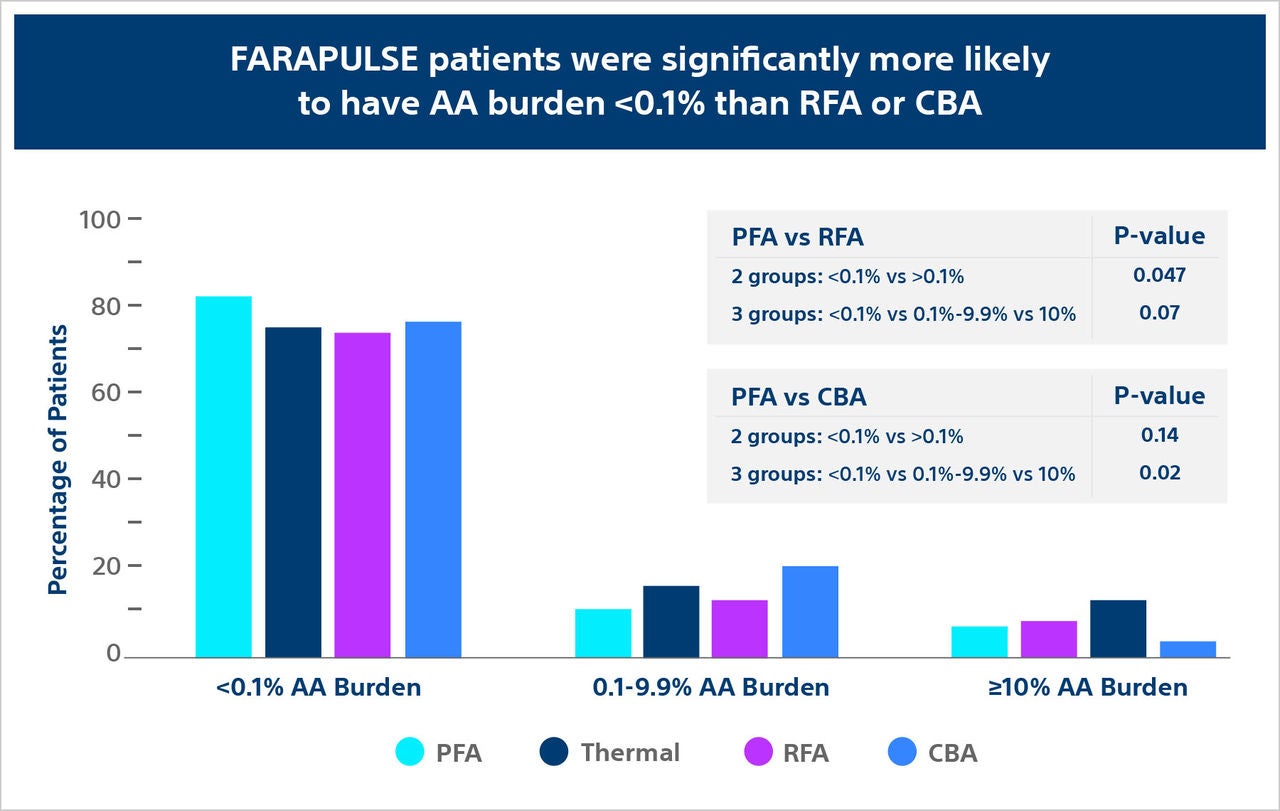
FARAPULSE PFA patients were significantly more likely to have AA Burden <0.1% than RFA and CBA 

(p=0.04)


Study design and methods: AA burden sub-analysis

  • During ADVENT, post-ablation transtelephonic ECG monitoring (TTM) was collected weekly and for symptomatic episodes and 72-hour Holters were collected at 6 and 12 months  
  • The TTM and Holter data was used to calculate the AA burden. Total AA burden was estimated by the greater of 2 values:  
    • % AA over total duration of Holter data or  
    • % of weeks of TTM with AA over total # of weeks with TTMs recorded 
  • Quality of life was assessed at baseline and 12 months. This sub-analysis included 593 (97.7%) patients. 

AA burden sub-analysis by ablation modality

Bar graph showing that FARAPULSE patients were significantly more likely than RFA or CBA patients to have AA burden less than 0.1%.

References

  1.  Reddy, V. Y. (2026). Pulsed field versus conventional thermal ablation for paroxysmal atrial fibrillation: 4-year outcomes in the ADVENT-LTO study. Nature Medicinehttps://doi.org/10.1038/s41591-026-04246-4
  2. Reddy VY, Gerstenfeld EP, Natale A, et al., Pulsed field or conventional thermal ablation for paroxysmal atrial fibrillation. New England Journal of Medicine.2023;Nov2;389(18):1660-1671. doi:10.1056/NEJMoa2307291  
  3. Reddy V, Mansour M, Calkins H. et al., Pulsed Field vs Conventional Thermal Ablation for Paroxysmal Atrial Fibrillation: Recurrent Atrial Arrhythmia Burden. J Am Coll Cardiol. 2024. 84(1): 61.74. https://doi.org/10.1016/j.jacc.2024.05.001

Boston Scientific Pty Ltd | PO Box 332 Botany NSW 1455 Australia | Tel +61 2 8063 8100

Approved intended use of device may differ for countries with applicable health authority registrations. Always refer to the product labelling for full instructions.

Bench Test or pre-clinical study results may not necessarily be indicative of clinical performance.

Results from clinical studies are not necessarily predicative of results in other cases. Results in other cases may vary.

You may be provided with links to other websites operated by Boston Scientific Corporation (BSC) or other third party websites located outside of Australia & New Zealand.  These websites may include information on therapies or products not approved for use in Australia and/or New Zealand and the content may not comply with regulatory requirements in Australia or New Zealand.  Please refer to the separate terms of use, privacy policies, and other rules posted on these linked sites before you use them. Third party links are provided merely as a convenience to you, and the inclusion of any link does not imply affiliation or endorsement by BSC. 

CAUTION: The law restricts these devices to sale by or on the order of a physician. 

Indications, contraindications, warnings, and instructions for use can be found in the product labelling supplied with each device or at www.IFU-BSCI.com. 

Products shown for INFORMATION purposes only and may not be approved or for sale in certain countries.

©2023 Boston Scientific Corporation or its affiliates. All rights reserved.

EP-1678203-AA